
An aviation emergency response plan that deploys when you declare
In 50 words
An emergency response plan sets out who does what when an accident or serious incident happens. In eAviora declaring a crisis deploys its checklist as a live task board, each task owned by a role on your crisis team, and the crisis stands down only on a written record that says where any open work went.
At a glance
The module, on one sheet
- Suite
- Safety Management · Emergency Response
- ICAO Annex 19
- Component 1, coordination of emergency response planning. FAA Part 5 requires it too.
- Records
- CRS crises and DRL drills
- Stages
- Active, Resolved
- In the box
- Accident and serious incident checklists, built on ICAO Annex 13
- Works with
- Action Plans, Documents, Training, Safety Promotion
What it does
Four things, done on the record
Declare, and the checklist deploys
Each task arrives on the board with its responsible role and the tasks it waits on.
A crisis team on file
The roster names who holds each response function, and every person mobilized answers for themselves.
Untouched tasks escalate
A mandatory task left pending goes to the crisis commander, or to the directors when none is named.
Drills that count
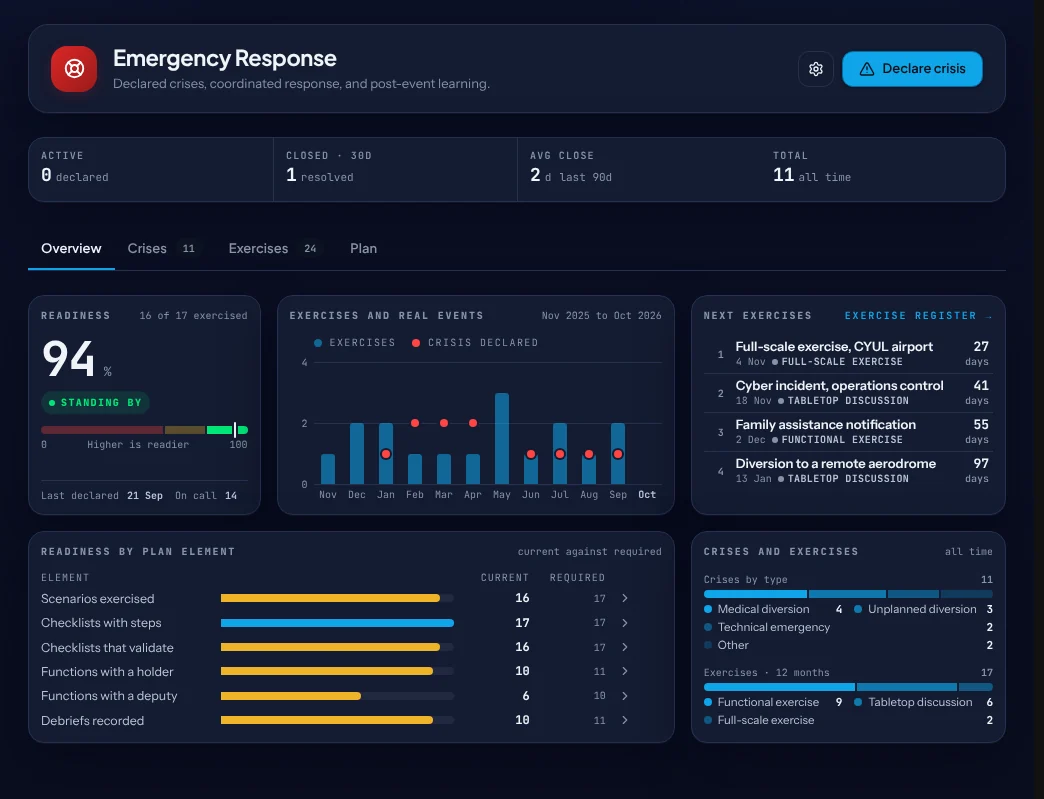
Tabletop, functional and full-scale exercises; readiness is the share of your scenarios exercised in the last year.
In the product
A crisis, while it runs
- The task board by department, each task with its role, status and what it waits on.
- The decision log, kept as the response runs.
- Who was mobilized, and whether they answered.
The rule it holds
A crisis stands down only on a written record.
Only the commander or an administrator can resolve it, naming a recovery owner, the control status, a handover plan and where any open mandatory task went.
On the graph
What it links to
Questions buyers ask
Short answers
Do we write the checklists from scratch?
No. Accident and serious incident response checklists ship, built on ICAO Annex 13. You can copy one and bind its tasks to your departments.
Who can stand a crisis down?
The crisis commander, or an administrator recorded as an override. Either way the stand-down record goes on file, and the crisis takes no new work after it.
What happens after the crisis?
You write the debrief once the crisis stands down. From it you can assign training or publish a safety bulletin.
See Emergency Response on your own records
A walkthrough with the people who build eAviora.