
We don’t manage safety. We prevent incidents.
Aviation safety intelligence for airlines and aviation operators.
Turn disconnected safety records into one governed operational picture. Occurrences, hazards, barriers, actions, audits, indicators and governance decisions on one operational graph, for SMS, QMS, security and compliance.
Built for
- Airlines
- MROs and Part-145 organisations
- Part 135 operators
- Ground handlers
- Training organisations
- Aviation authorities
Follow one record
From the report to the risk picture, in five steps
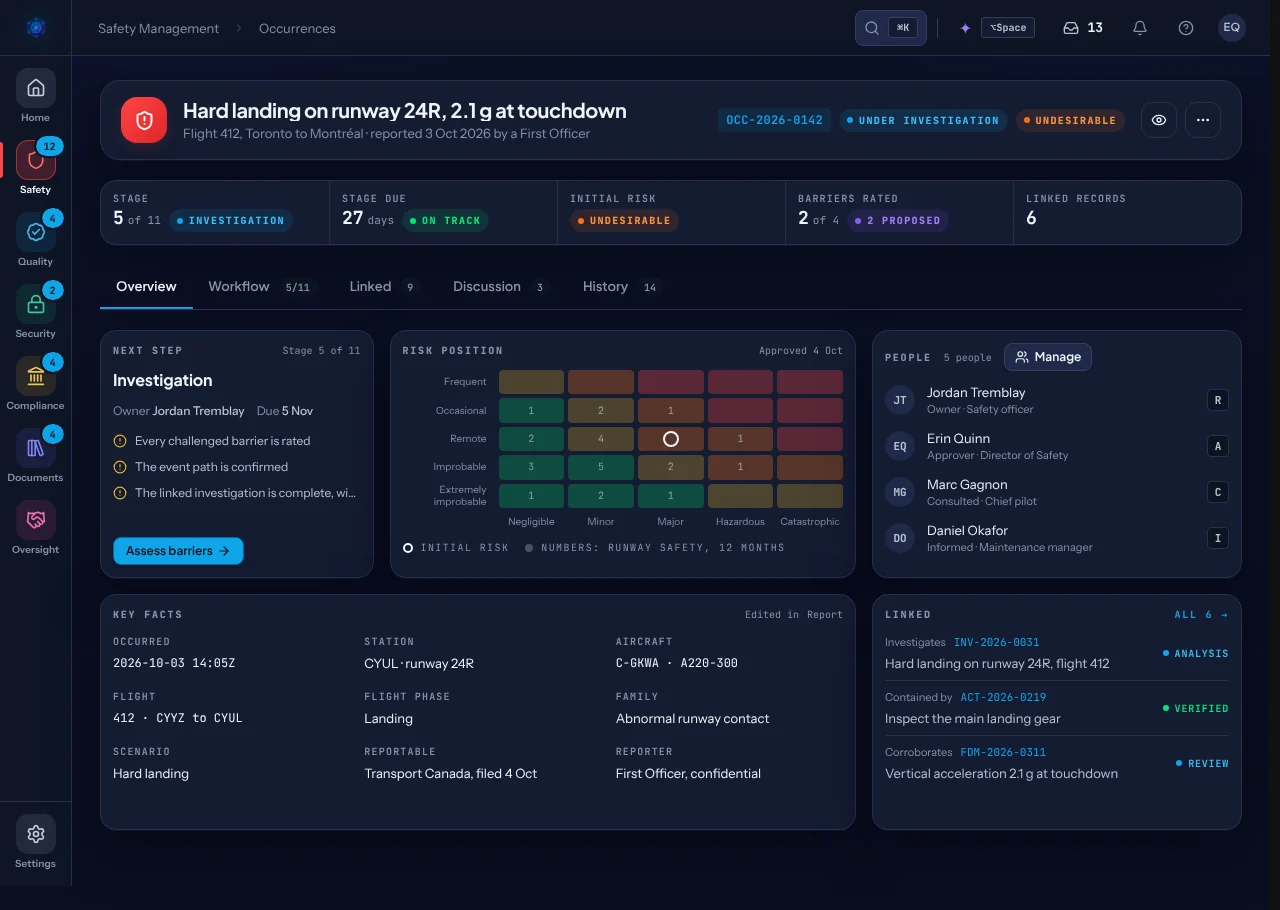
The same hard landing, as it moves through eAviora. Every step is a screen from the product.
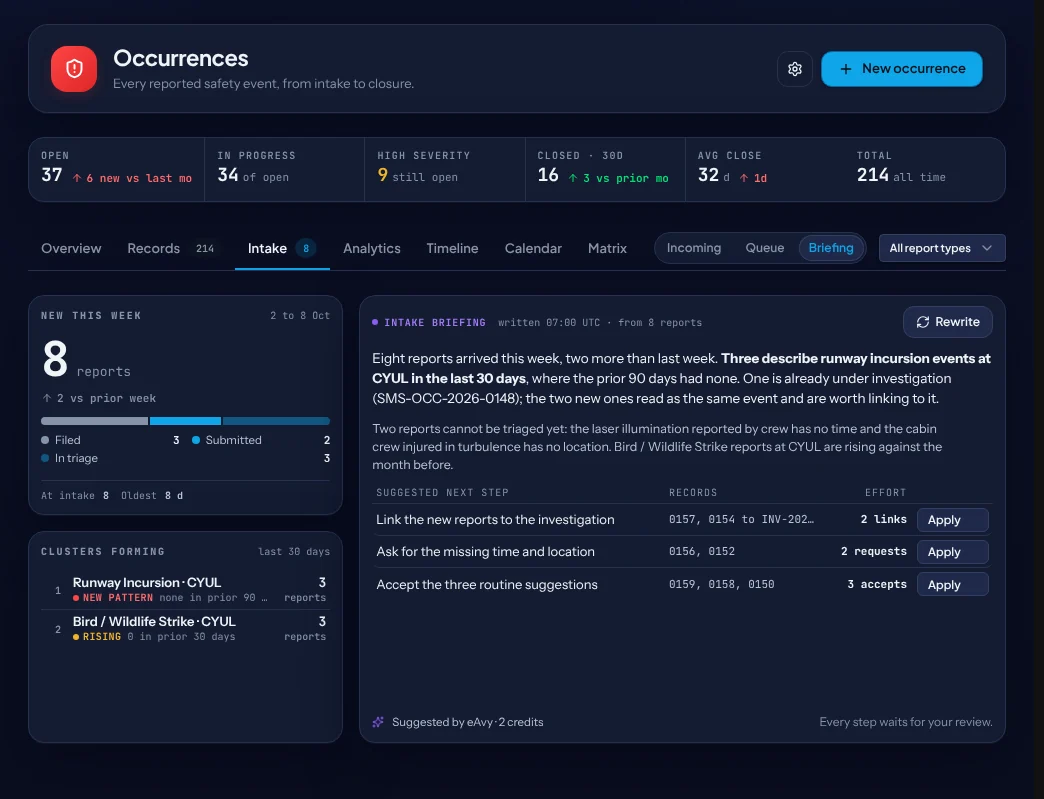
A report arrives from eAviora Field or the web. eAvy reads it and proposes a classification from your taxonomy, with its confidence; a person accepts it or changes it.
The risk is placed on the ICAO 5 by 5 matrix, the same for every operator. Initial and residual risk stay on the record, with who decided and when.
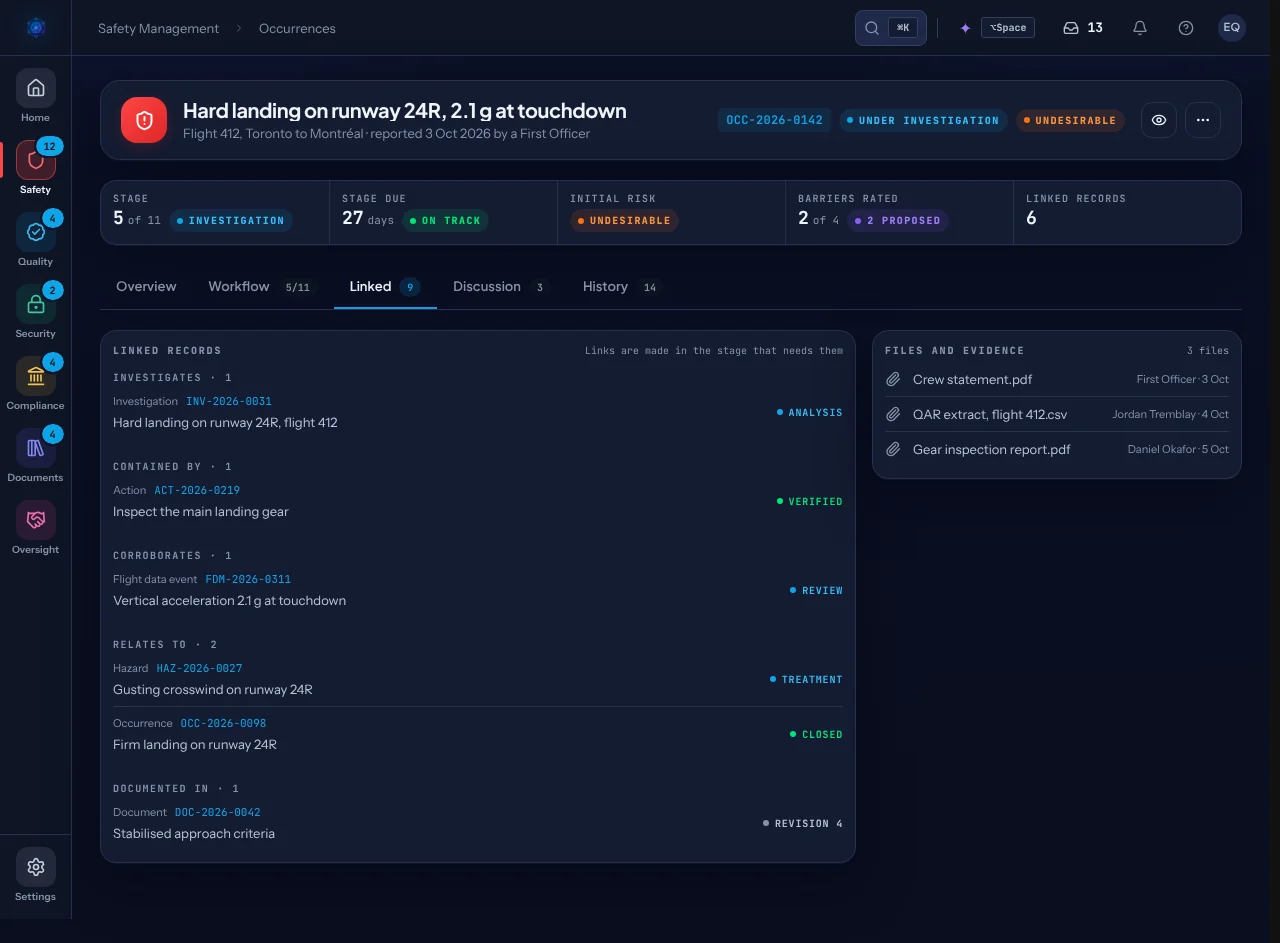
The occurrence links to the hazard it belongs to, the investigation, the corrective actions and the evidence. Each link is a record you can open, not a note.
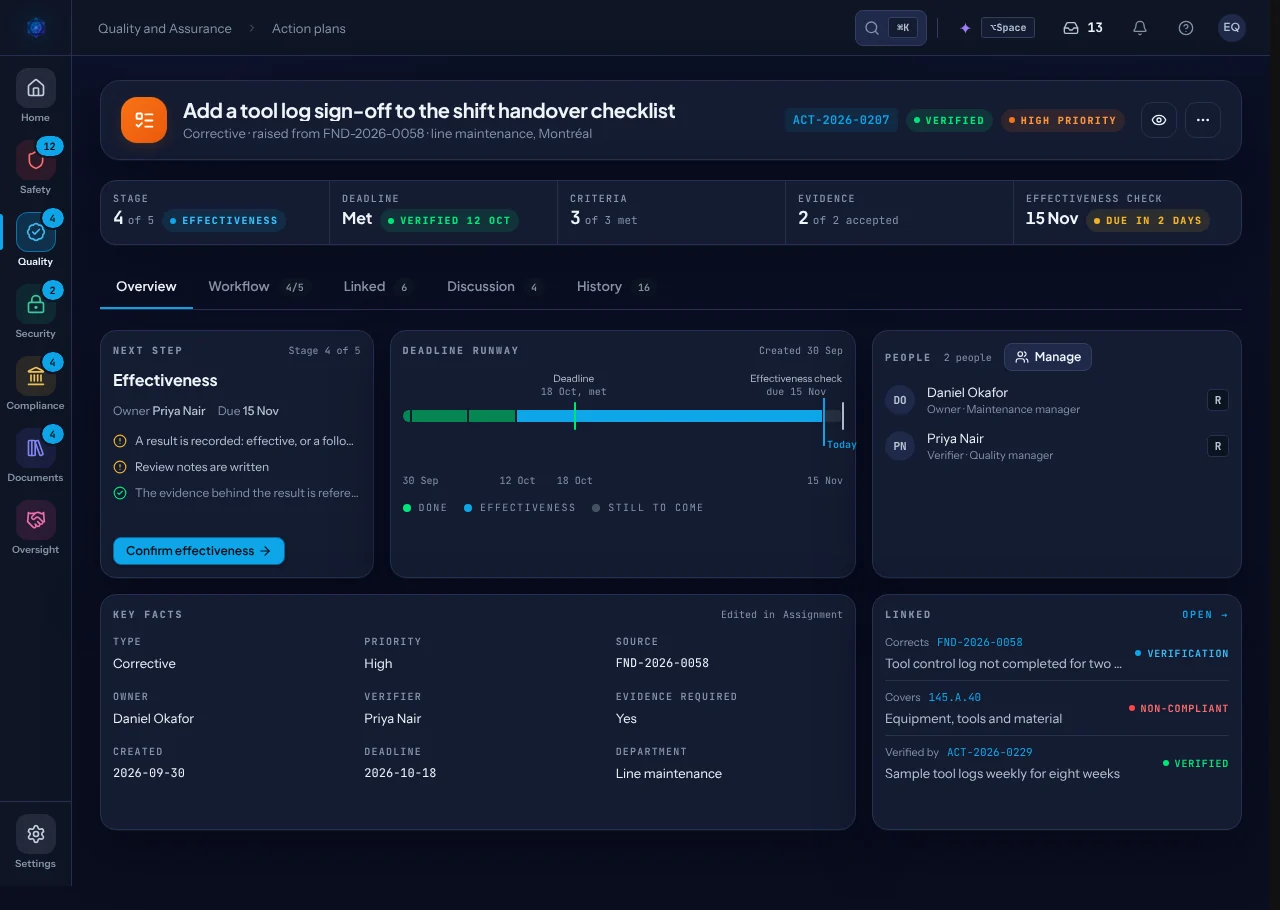
A corrective action carries an owner, a deadline and an effectiveness check before it closes. By default the owner cannot verify their own action.
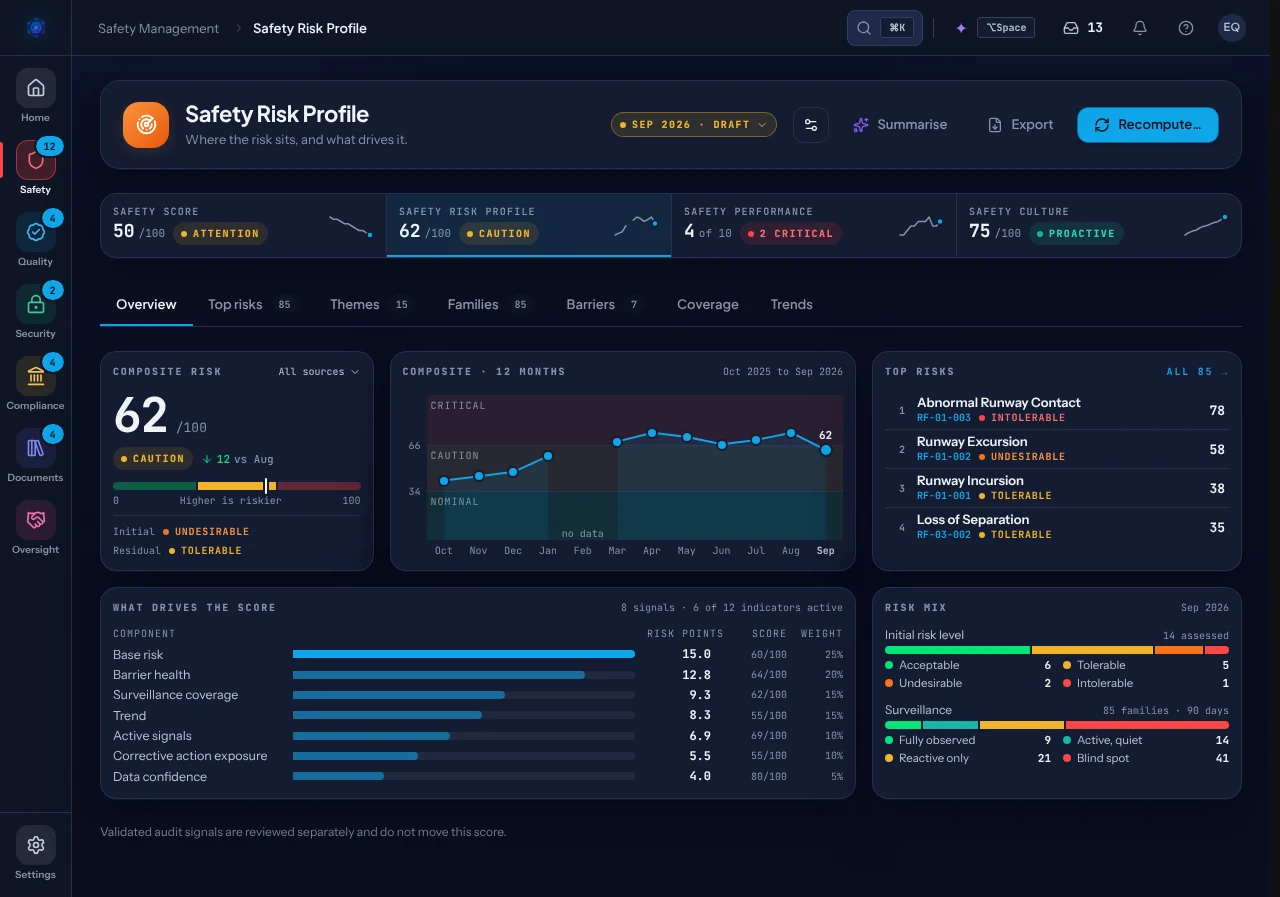
The Safety Risk Profile is computed from the records, so the review board reads the same picture the safety office works from, and every profile is kept as a snapshot.
Start from the job on your desk
What are you working on?
Five jobs buyers bring to us, with the rule behind each and what eAviora does for it.
The rule
Every Part 135 operator must have its SMS fully implemented, with a declaration of compliance filed with the FAA, no later than 28 May 2027.
What eAviora does for it
- Each Part 5 component (policy, safety risk management, assurance, promotion) has its own place in the Safety Management suite.
- Hazards are assessed on the ICAO 5 by 5 matrix, and corrective actions close on evidence, with an effectiveness check.
- Safety performance indicators are evaluated against their thresholds every day, so assurance is measured, not declared.
Not in the box today: the Part 5 requirements catalogue. Register Part 5 as a standard of your own, and its requirements sit on your compliance register with everything else.
The rule
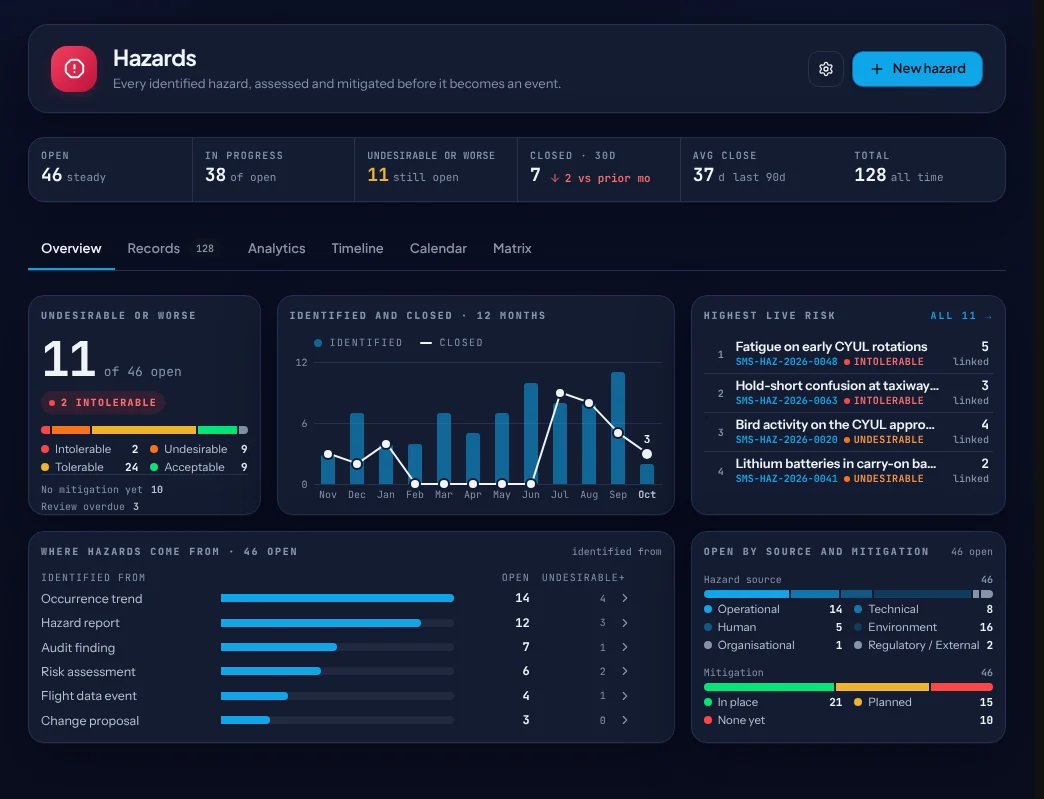
EU Regulation 376/2014 sets the clock: a reportable occurrence reaches the competent authority within 72 hours, and the analysis follows.
What eAviora does for it
- Set your jurisdictions, and a reportable occurrence carries its reporting deadlines on the record.
- Occurrence reports export as E5X for ECCAIRS.
- A reporter can file confidentially: their identity is not disclosed with the report.
Not in the box today: an EASA requirements catalogue. Register the rules you work to as a standard of your own.
The audit
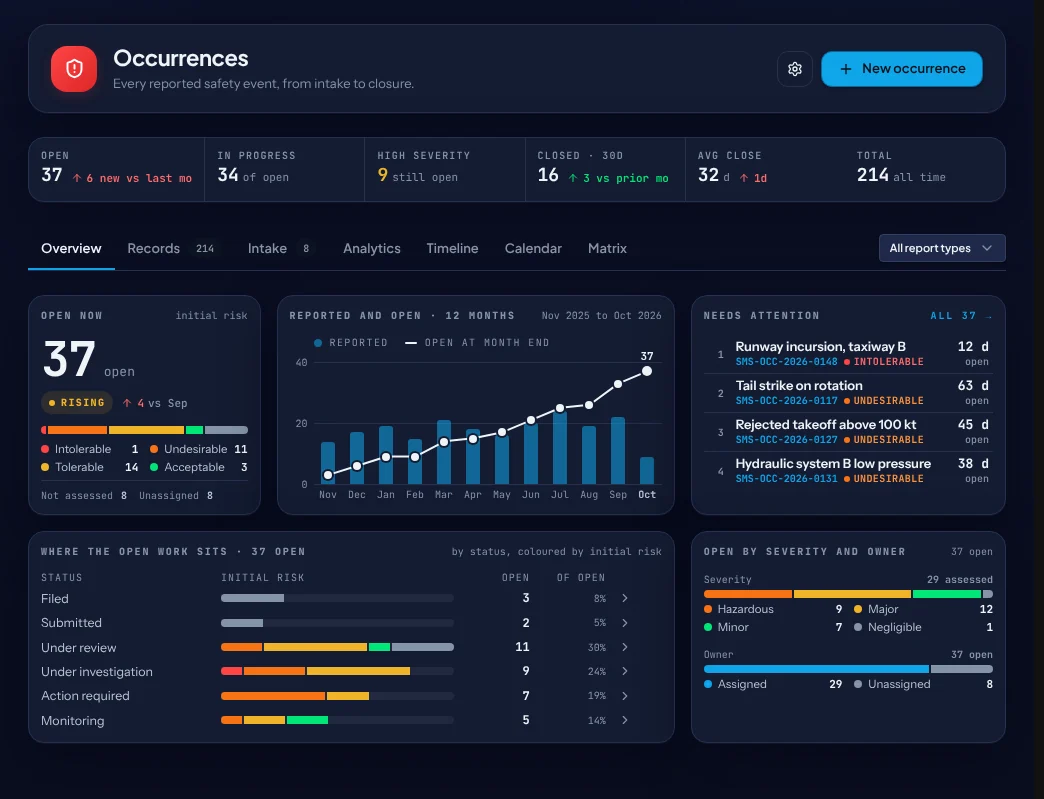
IOSA audits an airline against the ISARPs of IATA's IOSA Standards Manual, and registration is renewed every two years.
What eAviora does for it
- The IOSA Standards Manual ships in the box, editions 18 and 19, with the crosswalk between them.
- Each ISARP sits on your compliance register with its owner, its evidence and its assessment.
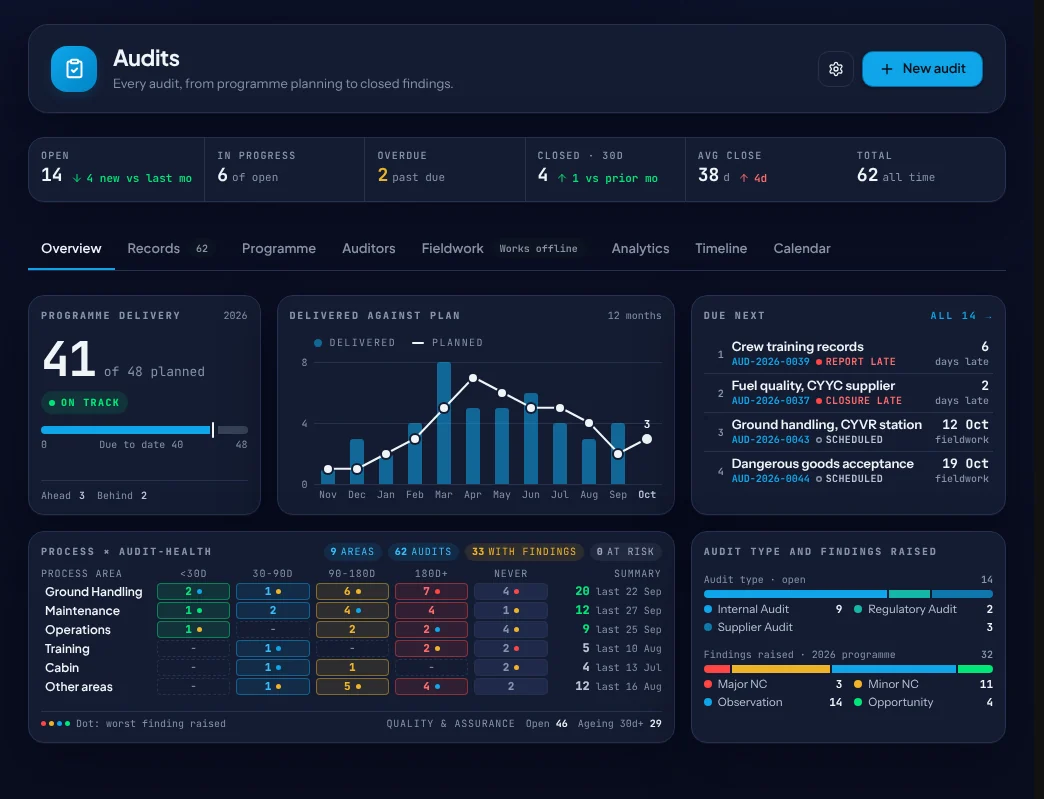
- Internal audits and their findings open corrective actions on the same graph.
eAviora holds your evidence and your readiness. The audit itself is run by an IATA audit organisation.
The rule
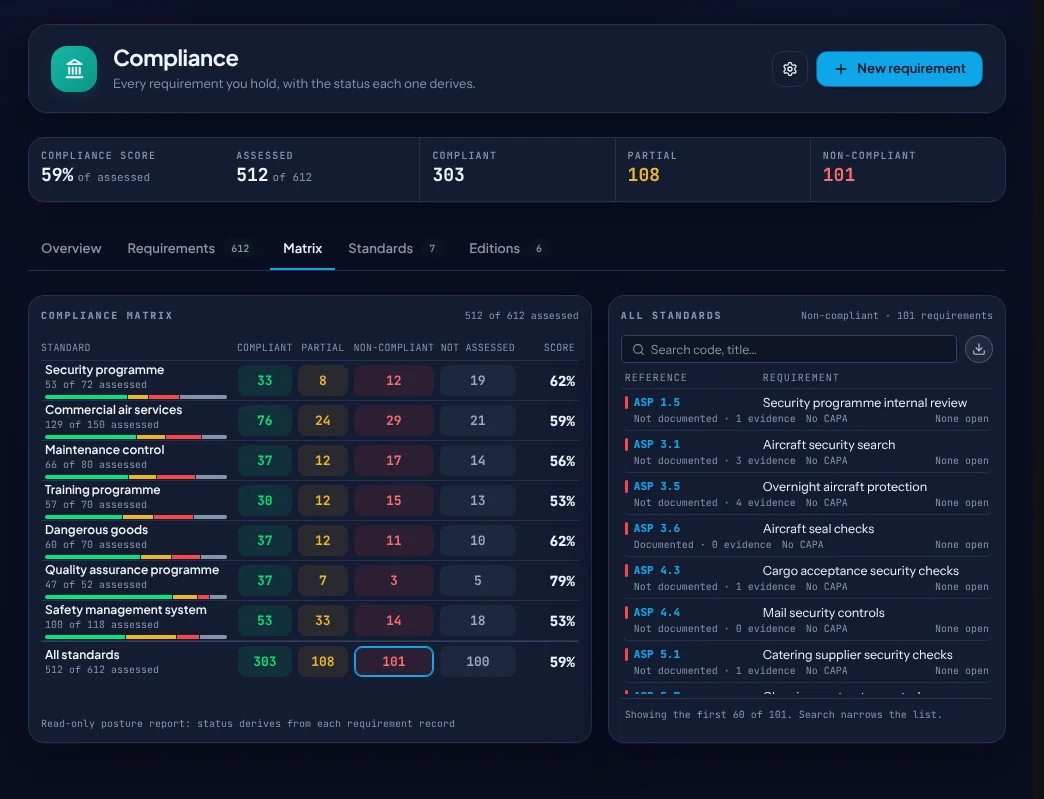
EASA Part-145 asks a maintenance organisation for one management system: safety risk management and compliance monitoring under one roof.
What eAviora does for it
- Hazards and occurrences in the Safety Management suite, audits and findings in Quality & Assurance, on one graph.
- Controlled documents with read and sign, and the training behind each role.
- Subcontractors and providers in Third-Party Oversight, with the records that prove your oversight.
Not in the box today: a Part-145 requirements catalogue. Register it as a standard of your own.
The situation
The register lives in spreadsheets and email, and the links between an occurrence, its hazard and its action live in one person's head.
What eAviora does for it
- Your history imports from CSV: the import proposes how your columns map, you check the rows before anything is written, and an import of records can be rolled back.
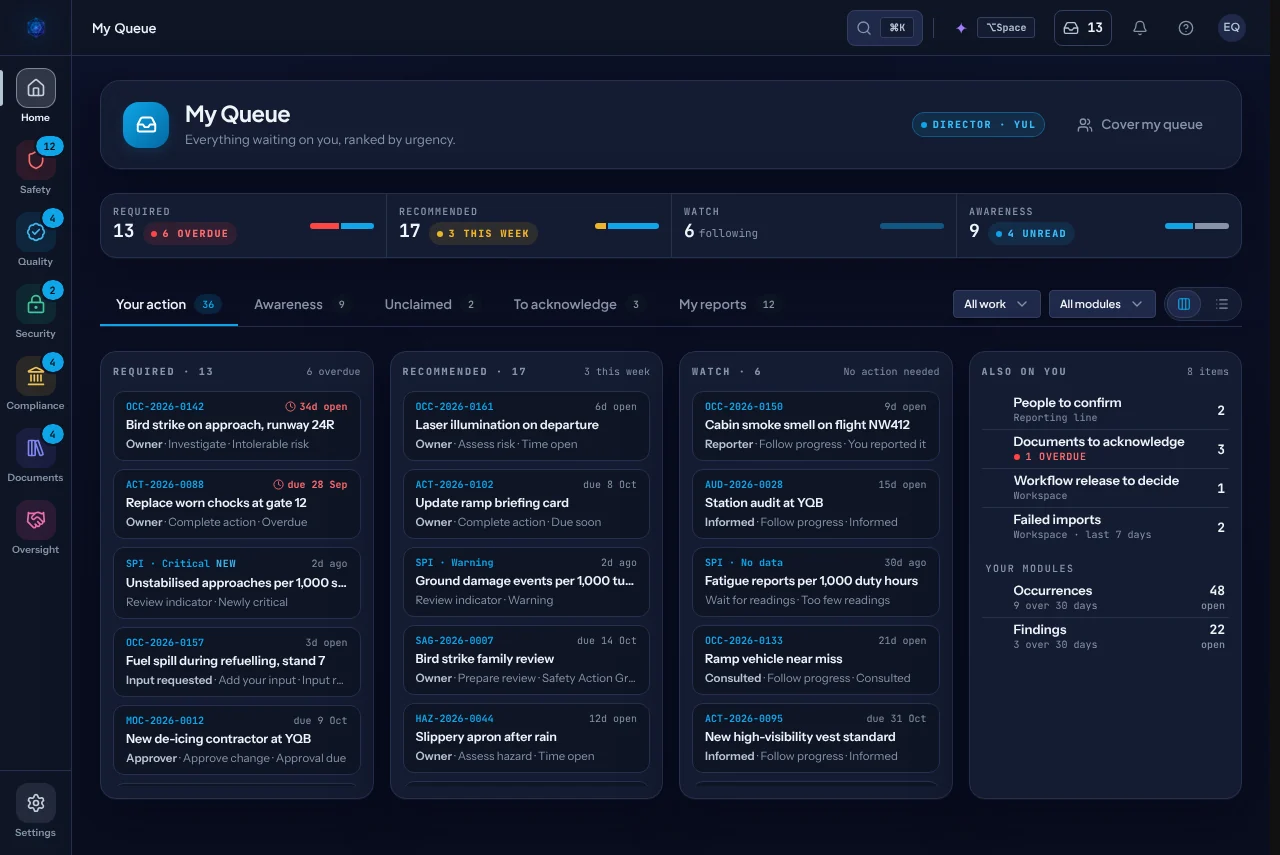
- Every person opens one queue with what is waiting on them, instead of a folder of email.
- Your data leaves with you: export as JSON or CSV.
What it takes to move your history in is quoted before you sign, against your operation size and the modules you run.
Six suites, one graph
The modules, grouped the way the product groups them
- Safety ManagementOccurrences, hazards, risk, investigations, governance and indicators. 14 modules in four pillars, one per ICAO Annex 19 component.
- Quality & AssuranceAudit programmes, fieldwork, findings, and the corrective actions they open.
- Security ManagementSecurity events, classified, assessed and closed on the same graph as safety.
- Compliance & RegulatoryRequirements from the IOSA Standards Manual and Transport Canada's CARs, with their evidence and gaps.
- Documents & TrainingControlled documents with read and sign, and the training and competence behind each role.
- Third-Party OversightPartners and providers, with the records that prove your oversight of them.
Shared across every suite: Action Plans and Evidence Hub.
The risk model ships in the box
Start on day one with a built aviation risk library
Bow-tie models, named barriers and indicator definitions arrive with the platform, so a new safety office starts from a model, not a blank spreadsheet.
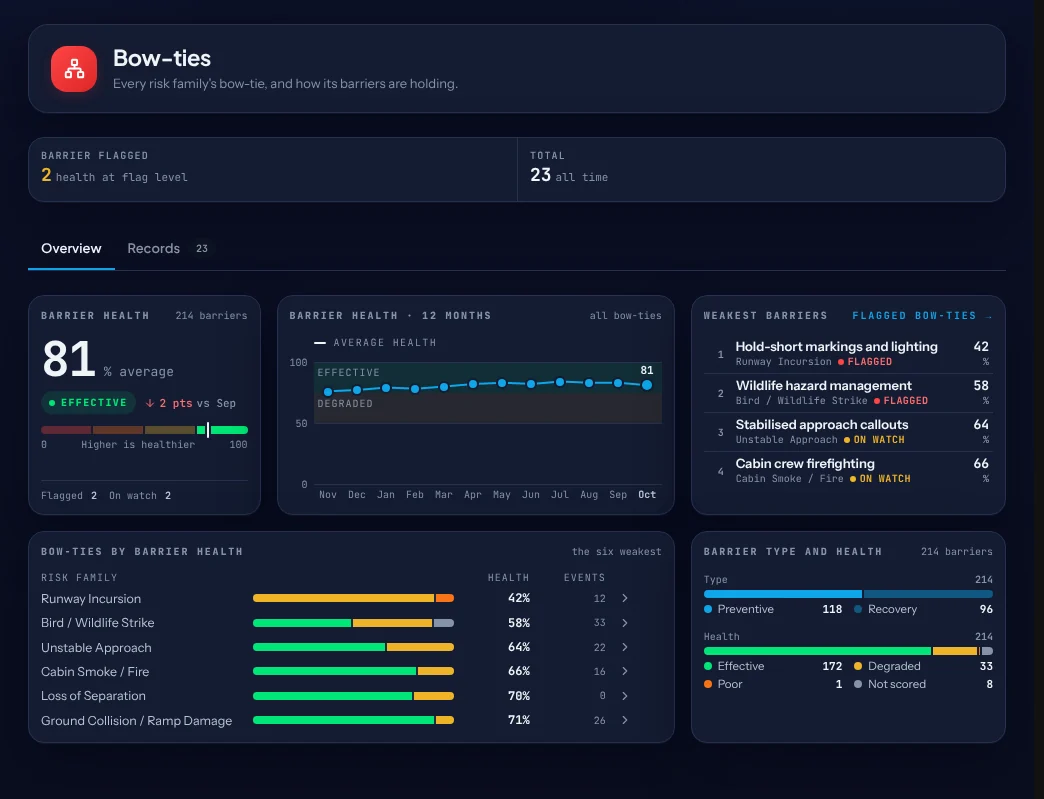
Counts read from the library the platform seeds, checked against it by a test on every build.
Built to be audited
What an auditor, a regulator or your security team will ask
Plain answers, with the detail on the trust center.
Read the trust centerEach organisation's records are isolated in the database itself
Row-level security on every organisation's tables, not only filters in the application.
An append-only audit log
Who changed what on a record, and when, kept beside the record.
eAvy proposes, a person approves
Nothing the AI assistant suggests is written to a record until someone accepts it. AI is metered in credits from one shared pool.
Your data leaves with you
Export as JSON or CSV, and occurrence reports as E5X for ECCAIRS.
SOC 2, stated plainly
SOC 2 Type I is in preparation. No certification is claimed today. Type II follows the required observation period.
Questions buyers ask
Short answers
What is eAviora?
eAviora is the aviation safety intelligence platform that connects safety, quality and compliance on one operational graph. It is built for airlines, MROs, ground handlers, training organisations and aviation authorities.
Which regulations and standards does it follow?
The safety management suite follows the four components of ICAO Annex 19 and Doc 9859. The compliance catalogue ships with the IOSA Standards Manual, editions 18 and 19, and Transport Canada's CARs and Standards; other authorities' requirements are added during onboarding. Occurrence reports export as E5X for ECCAIRS.
How much does it cost?
Pricing is quoted against operation size and the modules you run, on an annual subscription. AI is metered in credits drawn from one shared monthly pool for the whole organisation, and extra capacity is bought in prepaid packs, so there is no surprise invoice.
Is there a mobile app?
Yes: eAviora Field, an offline iOS field app on the same platform, so a report filed with no signal is the same record the office reads.
Does eAviora train AI models on our data?
No. eAviora does not use your records to train or fine-tune any model. AI proposes and a person decides. The trust center names the processor that handles AI requests.
See it on your own operation
A walkthrough with the people who build eAviora, on the scenarios you bring.