
The platform
One operational graph for safety, quality and compliance
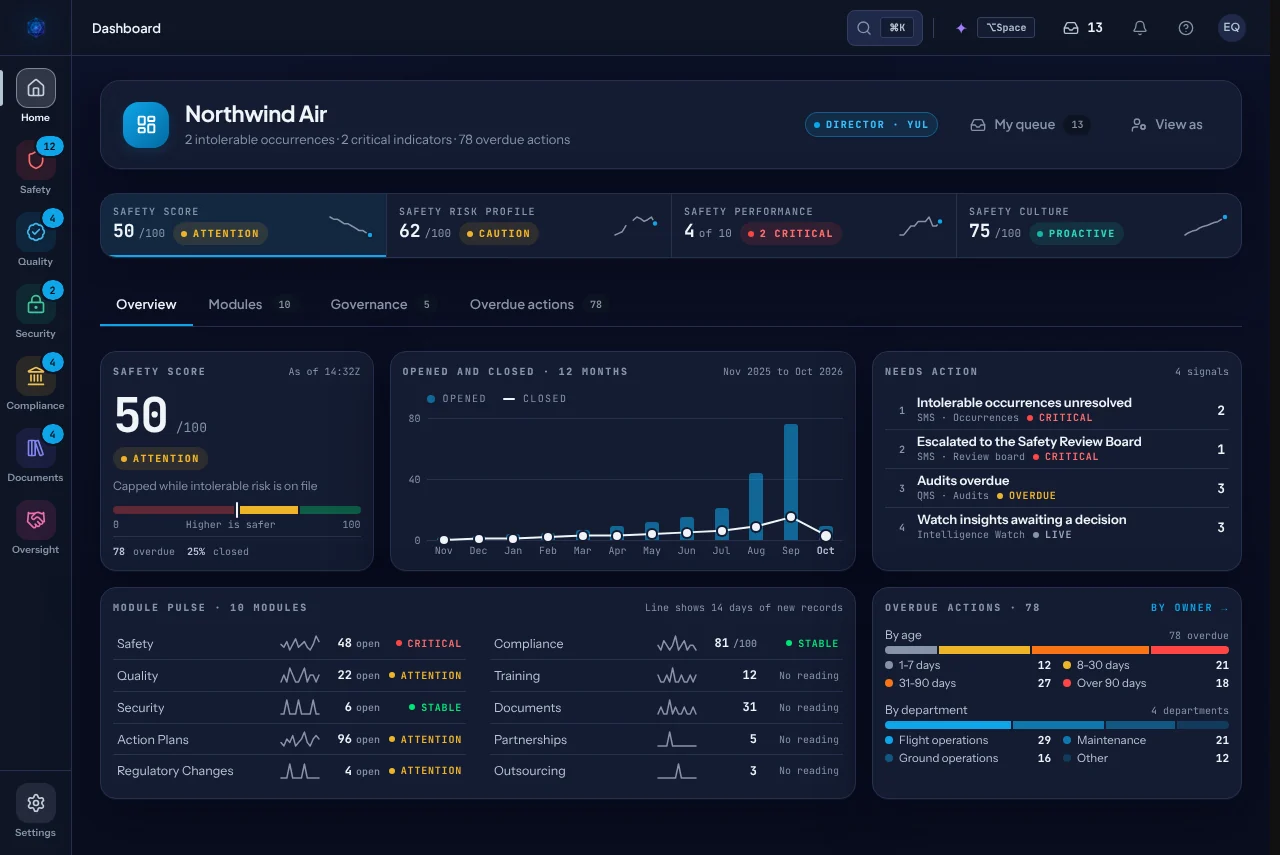
One operational graph connects occurrences, hazards, barriers, actions, audits, indicators and governance decisions. SMS, QMS, security and compliance in one governed picture, for airlines and aviation operators.
One record
Every record opens on the same five tabs
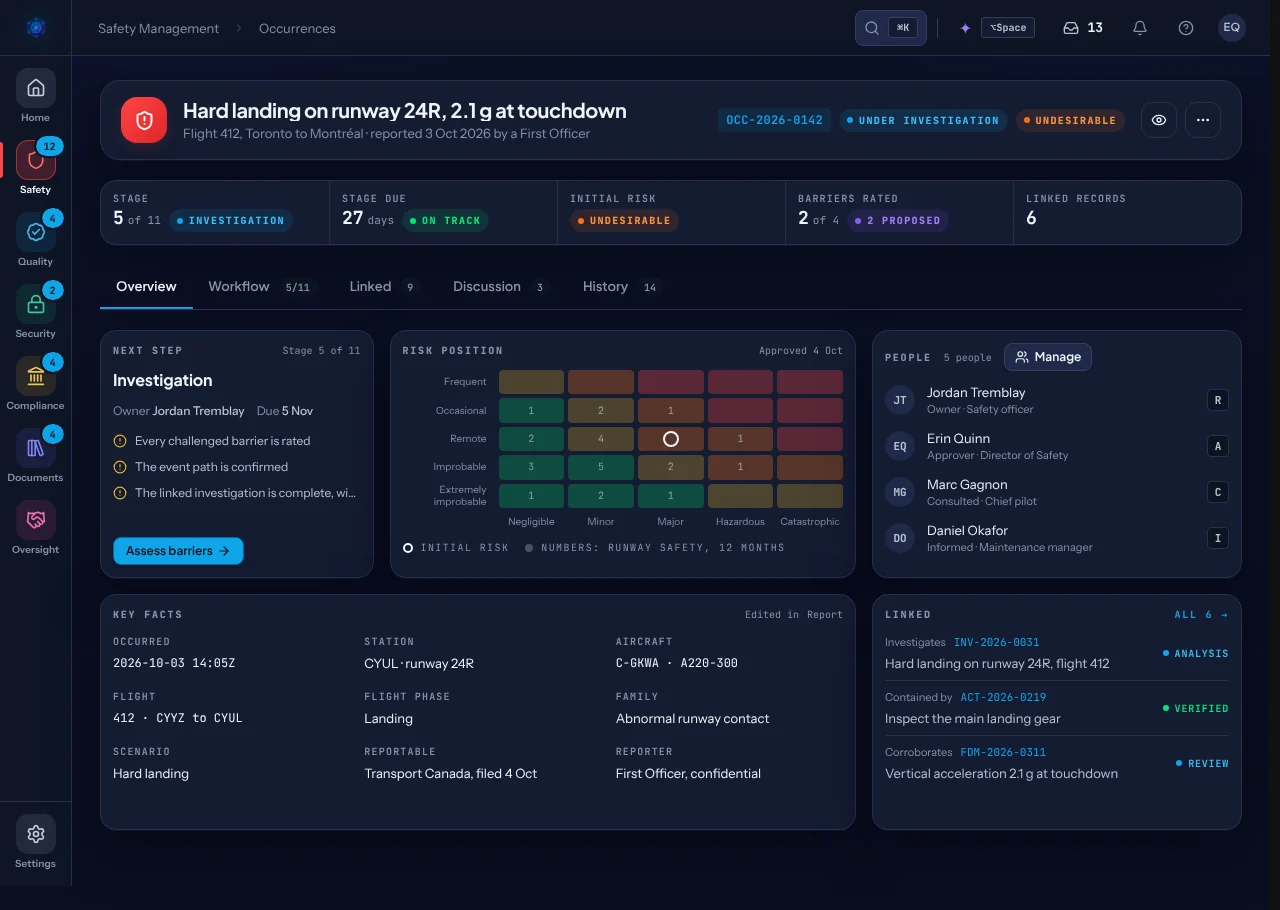
Overview, Workflow, Linked, Discussion and History, whether it is an occurrence, a hazard, an audit or an action. Three of them, on a hard landing:
Where the record stands
- Its stage, and the next step with what it is waiting on.
- Its risk position on the 5 by 5 matrix, with who approved it and when.
- The people on the record and what each one owes.
The operational graph
The links are records too
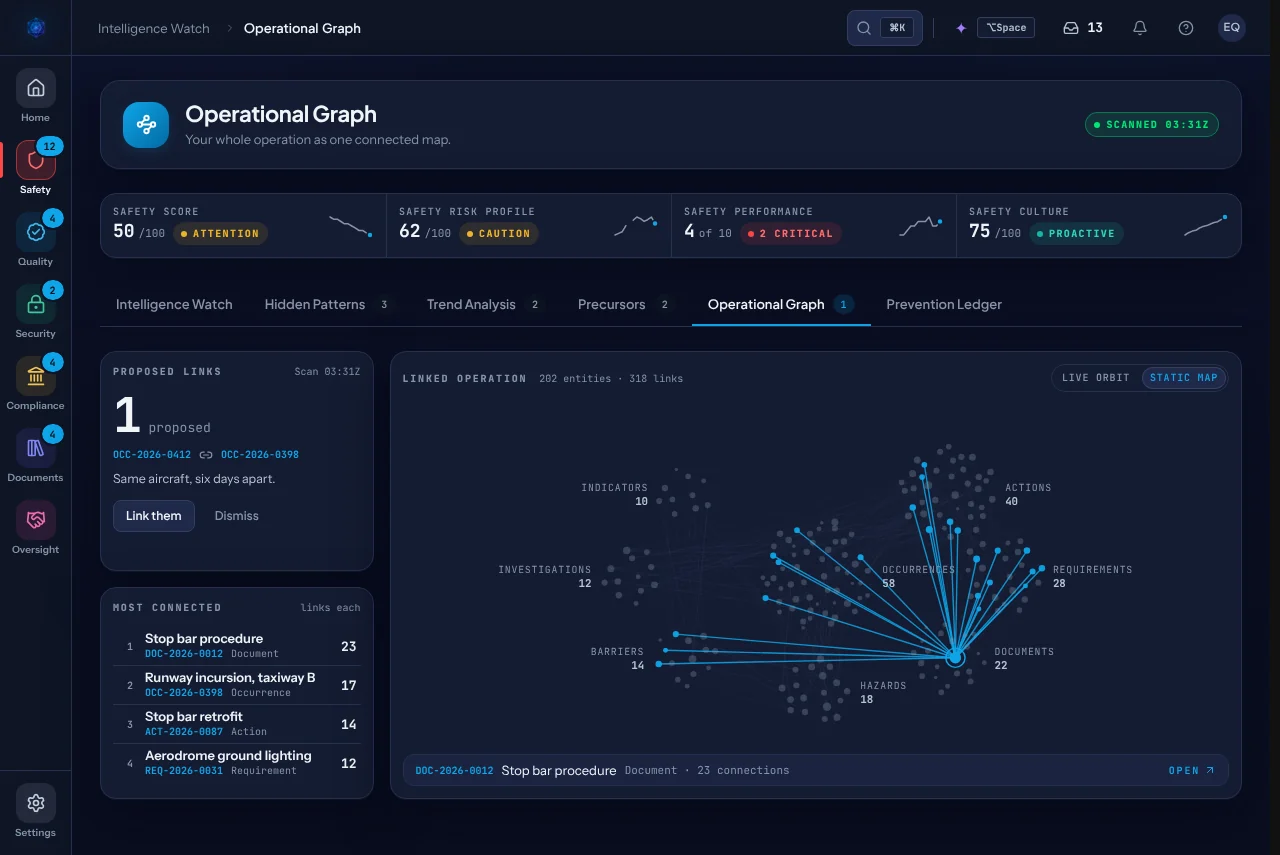
Occurrences, hazards, barriers, actions, requirements and documents, with the link between each pair named and kept.
Linked as the work is done
An investigation opened from an occurrence is linked to it; an action raised from a finding is linked to its source.
Proposed links wait for a person
The platform proposes links it finds, such as two occurrences on the same aircraft six days apart. Someone links them or dismisses them.
Risk is computed, not declared
A risk profile the records produce
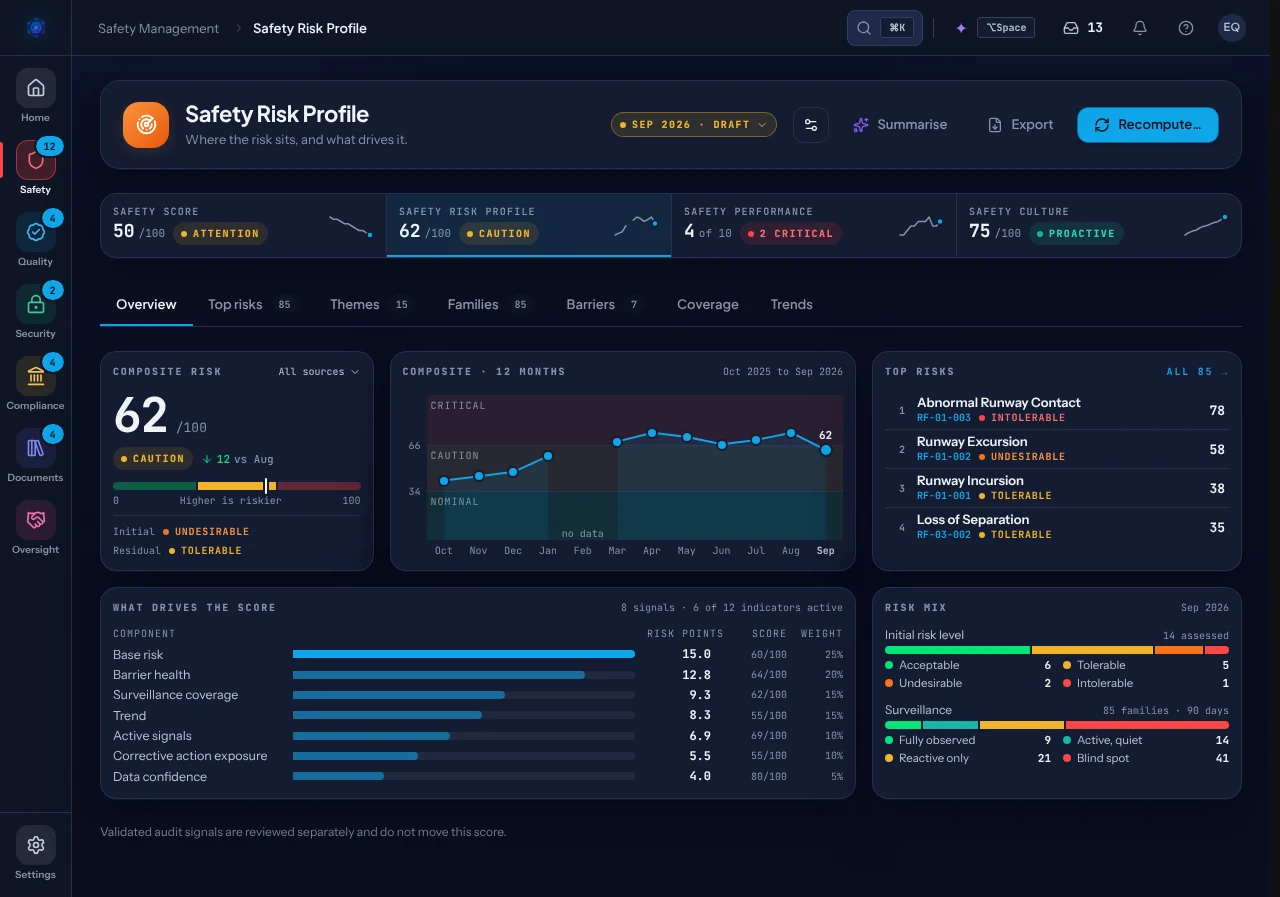
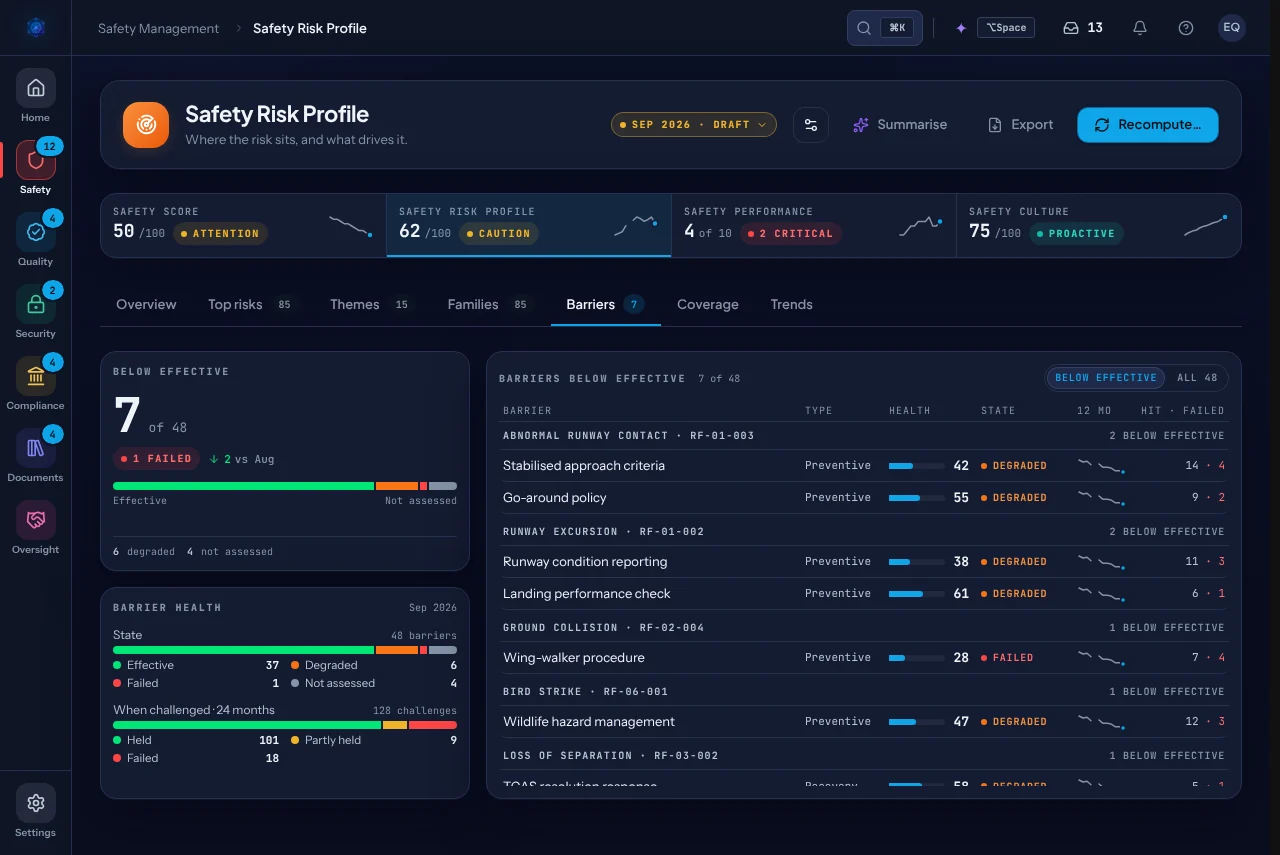
Seven named components, fused into one banded score per risk theme and shown beside its worst ICAO risk level. Each profile is kept as a snapshot, so the board reads the answer it was given.
- Base risk
- Trend
- Barrier health
- Active signals
- Corrective action exposure
- Data confidence
- Surveillance coverage
The model ships in the box
A built aviation risk library, assessed against your operation
Bow-tie models with named barriers and indicator definitions arrive with the platform. Barrier health is read from how each barrier held when it was challenged.
Counts read from the library the platform seeds, checked against it by a test on every build.
Taxonomy codes and indicator definitions are versioned. You map your own terms to them, so last year stays comparable with this year.
Closure is governed
A record closes on evidence, not on a checkbox
Barriers are rated before the record moves on
Every barrier an occurrence challenged is rated, unless your risk policy says a band does not need it.
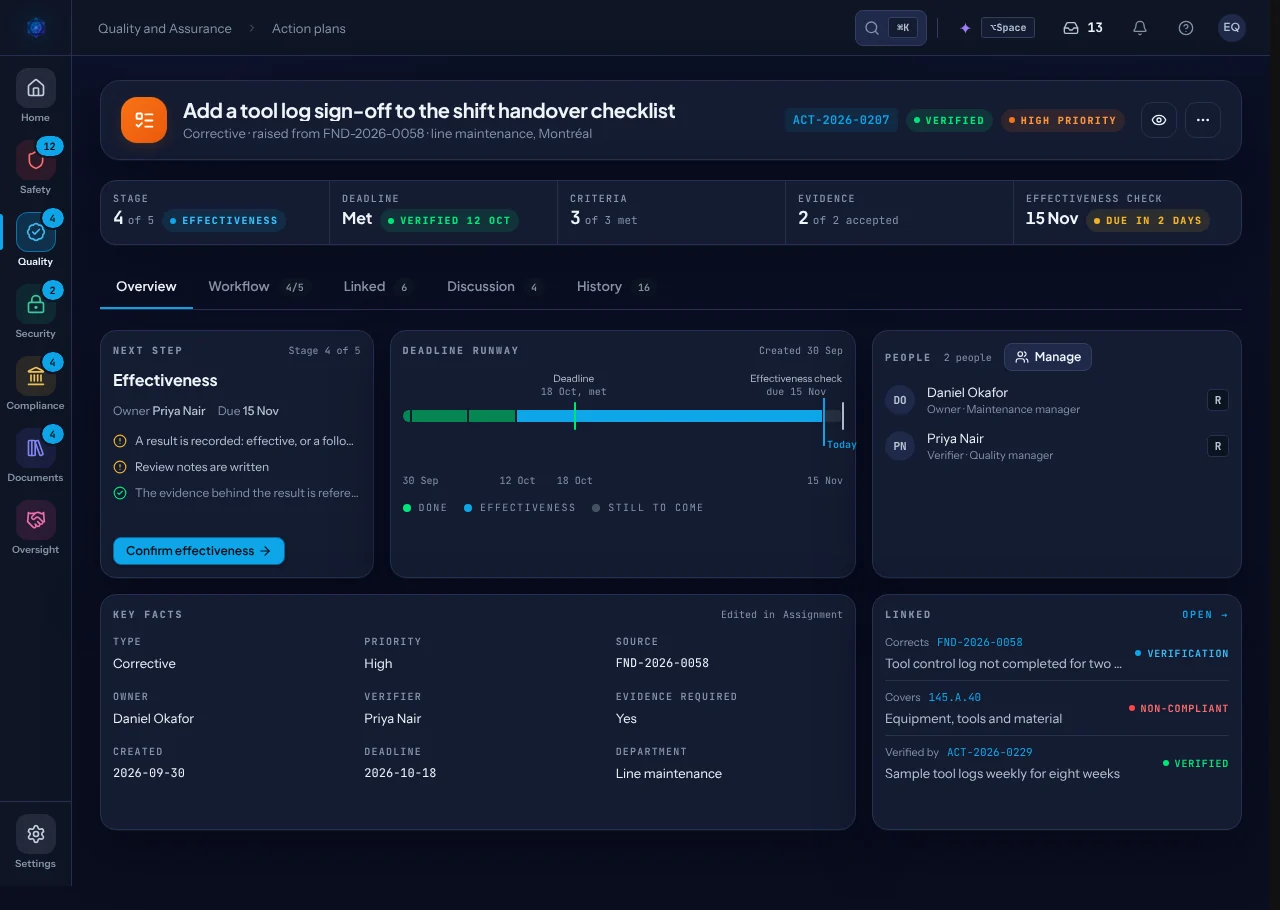
Actions close after an effectiveness check
The check is on by default and set by policy, so the fix is proven before the action closes.
The owner is not the verifier
By default, the person who owns an action cannot be the one who verifies it.
Governed AI
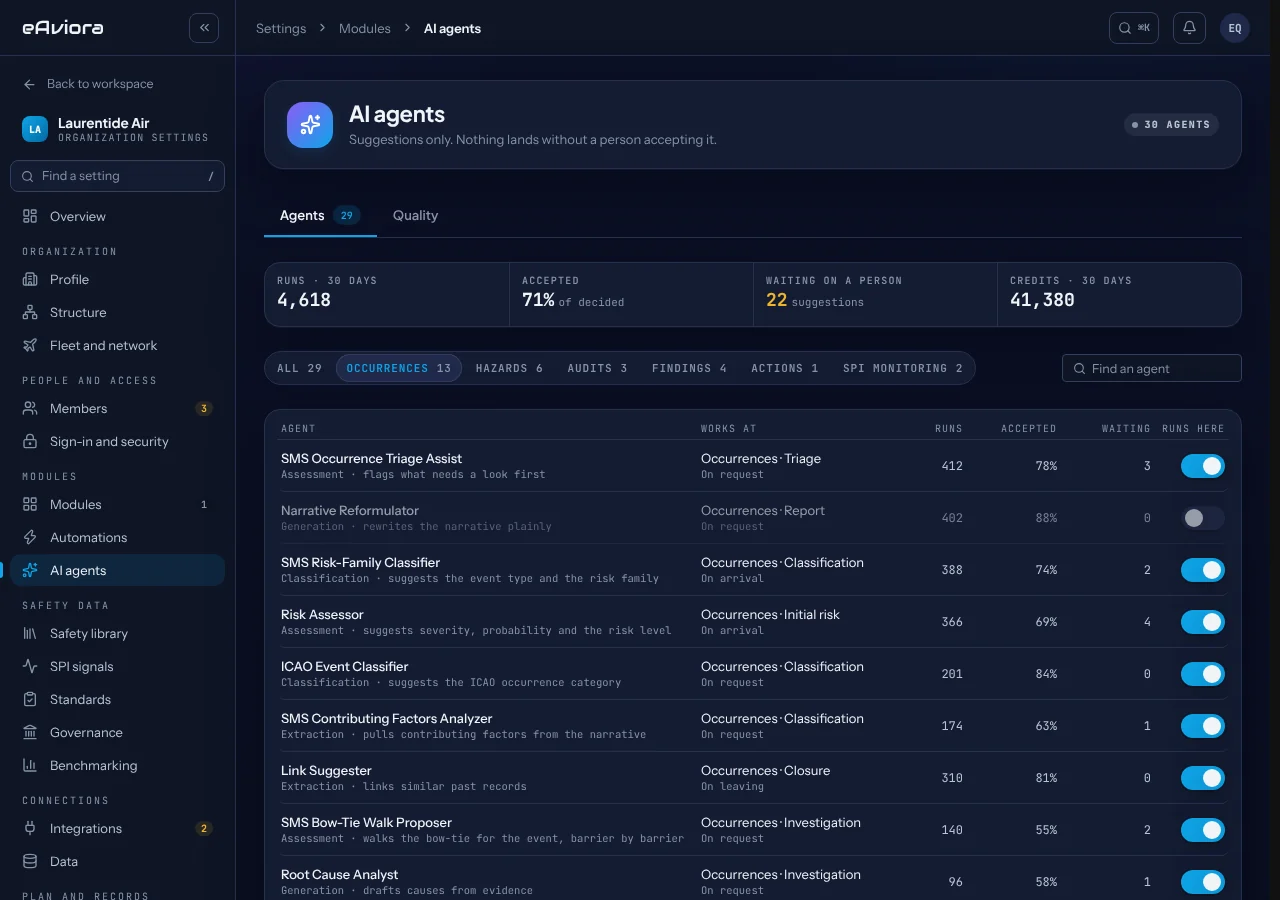
AI proposes. Humans approve.
eAvy and a fleet of specialist AI agents read records and propose: a classification, a risk, a link, a draft. Nothing they suggest is written to a record until someone accepts it, and the decision is kept with the reviewer’s name.
Who reads it
Different teams, the same records
The safety manager
Works a queue of what is waiting on them, ranked by urgency, not an inbox.
The quality lead
Reads each requirement with its evidence, owner and assessment, drawn from the records.
The accountable executive
Reads one computed risk answer per theme, kept as a snapshot.
The auditor
Follows the trail from a finding to the action, the evidence and the people who verified and closed it.
Built to pass an IT review
Open to your systems, closed to everyone else
A documented, versioned REST API
With an OpenAPI description generated from the same definitions the API serves.
A connector for AI assistants
An MCP server that is isolated per organisation, checked against each user’s permissions and audited.
Enterprise identity
SAML single sign-on, SCIM provisioning and multi-factor sign-in.
Isolation in the database itself
Row-level security on every organisation’s tables, and signed webhooks for the events your systems subscribe to.
Questions buyers ask
About the platform
Is eAviora an SMS?
It includes one. The Safety Management suite covers the four components of ICAO Annex 19, and the same graph carries quality audits, security events, compliance, documents and training.
Can we start with some modules and add others later?
Yes. Pricing is quoted against the modules you run, and a module you add later writes to the same graph as the ones you started with.
Does it work on a phone?
The web app works at phone width, and eAviora Field is the iOS app for filing reports where there is no signal.
Can we get our data out?
Yes. Records export as JSON or CSV, and occurrence reports as E5X for ECCAIRS.
Bring one of your records
A walkthrough on your own operation, with the people who build eAviora.