
Aviation safety intelligence that reads the whole operation every day
In 50 words
Safety intelligence looks across all your safety data for what no single report shows: repeating patterns, rising trends and the precursors of an event. In eAviora the Intelligence Watch scans the whole operation every day, keeps each finding as an insight with its evidence, and leaves the decision on it to a person.
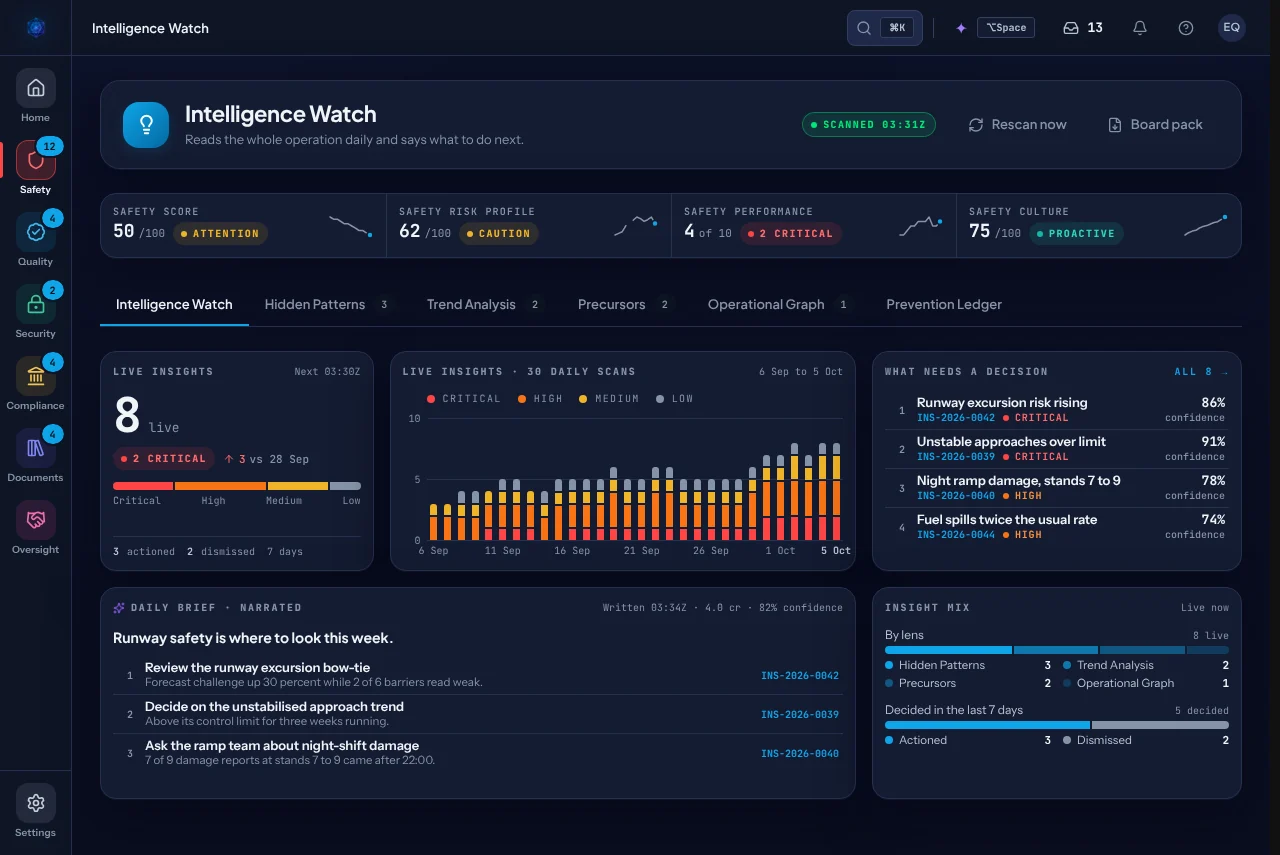
At a glance
The module, on one sheet
- Suite
- Safety Management · Safety Intelligence
- Scan
- Every day at 03:30 UTC, and on demand
- Records
- INS insights, each with its own case file
- Lenses
- All insights, Hidden Patterns, Trend Analysis, Precursors, Operational Graph, Prevention Ledger
- Daily brief
- Written from what the scan found, and nothing else
- Works with
- Occurrences, Hazards, Safety Performance Indicators, Governance
What it does
Four things, done on the record
One scan, every day
The scan reads the operation through the same engines your boards run, and you can rescan on demand.
Four kinds of insight
Hidden patterns, trends, precursors and connections between records, each kept with the evidence behind it.
Insights that expire
An insight the scan stops seeing for 14 days expires, so the list holds what is true now.
Dismissed means dismissed
Dismiss an insight with a reason and the scan does not raise it again.
In the product
An insight, in its case file
- What the scan saw, the records behind it and when it last saw it.
- The next steps: raise a hazard, put it on the governance agenda or link the records.
- Its reference, and the day it expires if no scan sees it again.
The rule it holds
The scan never writes a record.
It proposes insights; raising a hazard, linking records or taking an item to the board is a person’s decision.
On the graph
What it links to
Questions buyers ask
Short answers
Does it change our records?
No. The scan proposes insights. A person raises the hazard, links the records or takes the item to the board.
How often does it run?
Every day at 03:30 UTC for each organisation, and whenever someone presses Rescan now.
Is the daily brief written by AI?
The brief is built from what the scan found. eAvy can narrate it, and never adds a number the scan did not produce.
Reading
From the insights library
See Intelligence Watch on your own records
A walkthrough with the people who build eAviora.